
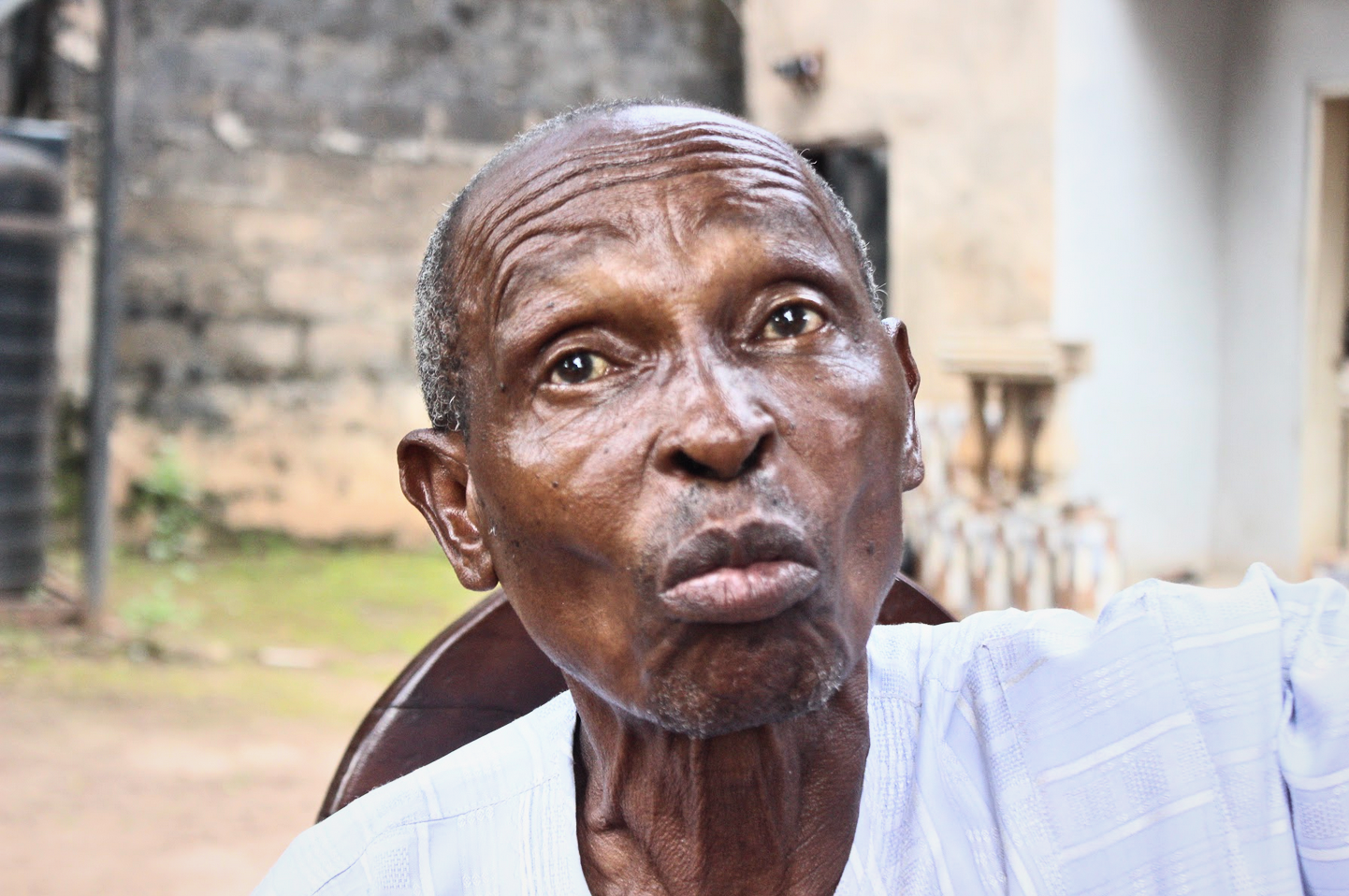
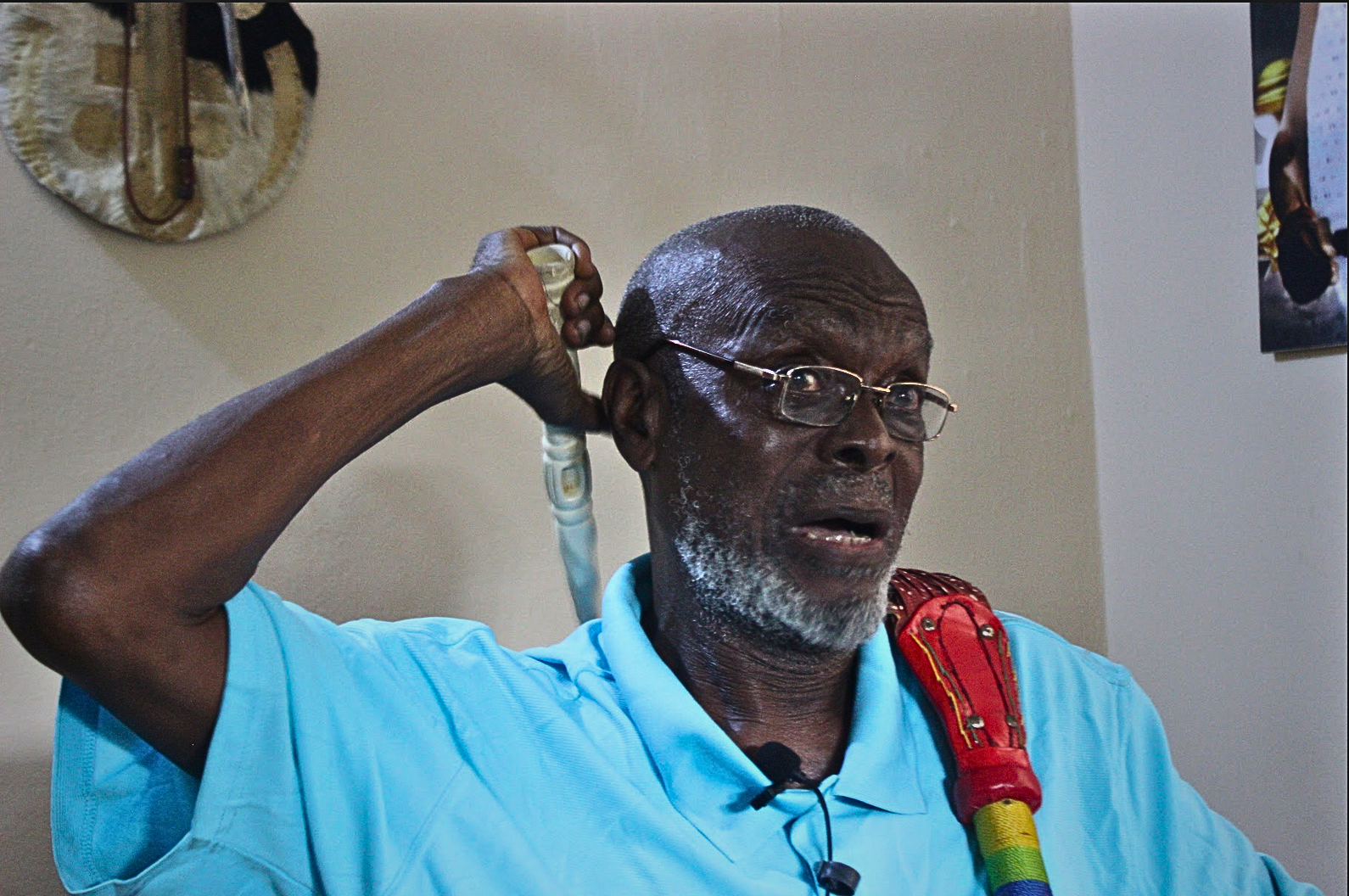
Okay, my name is Lazarus, Mr. Lazarus Agiriga. I’m from Ihube, Okigwe, local government of Imo State now. I schooled at St. Christopher Catholic Mission, Ihube, a primary school there. Then after that, I went to St. Simba Seminary, Umuahia, because my father was a Catechist and then, after God, reverend father and a catechist. And the reverend father there was Irish priest, not black men. Then, few years in the seminary, the war broke out. Due to my size, I came to Enugu to enlist myself as a military officer. Because there was a kind of a campaign, mounted to people there. Go out and defend your father’s land.

Then, we came out from the seminary school, came to Enugu. Then, our size was rejected because we were little. And it was hitting on us that we will go to fight the Northerners. Then, when we were rejected, they asked us to go to Four Corners and enlist our names as a boy’s company. Do you understand me? Then we went to Four Corners and we were welcomed. Then they enlisted us, what was our duty there was to go like rag children to monitor the position of the vandals. We called them vandals there during the war. So, when we find their location, we came back in the day or in the evening to give the commanders, the foot soldiers, the position of the enemy. If it is a matter of shelling them, then they can shell them because we were too small then to carry on. I was at least 16, 17 years then and I was very little.
“Then, we went into the enemy’s camp. They were too generous to us.”
So, they asked us to go as boys who lost their parents. Then, we went into the enemy’s camp. They were too generous to us. They gave us a good aids. They do anything they can do. Even they asked us to go and tell our leaders or our fathers to stop the war that we are the same. But that is not our mission, what we are sent to do.
So, we left Ogwo, come down to Okigwe because there is a time. The war was too sweet. 1967, everything was available before you are recruited into the army, you must have had a father in Abraham because everything is very, very abundant. It was 1967, 1968. The end of 1968 things continue to get sour. When Bakassi was blocked, there was not enough supply again to go around the country. Then, most of the uniforms that were imported were cut off. Then, CCN at Onitsha cotton mile, continue to produce military uniform. Then by then, our men continued to wear rag and what have you. So, along the line, the war continued to go. They continued to do all sorts of things in order to survive. Then, when the war ended, then everybody looked for his way out.

So, my activities are, as a boys scout, are to go into the war front. You will cross Biafran area of operation. Go inside to locate where the vandals, the enemies are. well, my personal experience. We don’t know whether one is dying or not. We are very happy to do that. To fight for our country, the survival of our country, Biafran we were doing it, nobody forced you. And you don’t demand money. Only you are happy that you are. Your peer groups are there, and you are there too. Do you understand me? Your peer groups are there, and you are there equally and we derive joy in serving our fatherland. We don’t look for money. Anything being given to you at the end of the month, you are satisfied.
“In 1968, things started to get worse because there was a lot of shortage of supply and manpower.”
What is of feeding, right? Well, the military feed us. They feed us because we have a camp where we gather, where we have been trained, where lectures have been given. In fact, we had every good things from the time we entered Boy’s Company. Feeding is like no man’s business. We eat. But, it was at the end of 1968, everything continued to get worse. From 67 to 68, it was luxury.
Then, early 68, when the Bakassi Peninsula was blocked, there was no supply, again, that flew from outside the world that comes to Biafran land. There was a lot of shortage, both material and weapons. So, at that time, you would be happy that you carried arms to fight no matter your size. And as an officer, you would be given a “backsman.” What we call “backsman” is this ADC. This, there current ADC. They call them “backsman.” Who goes for errands for you and is always standing behind you. So, at that time, we derived a lot of respect. Hey! No matter how small they are, they volunteered themselves to serve their fatherland.
St. Simba Seminary Umuahia that was the seminary I was before the breakout of the war and everybody was sent down to his or her community to go and join Biafran Army to defend the Biafran land. People from University of Nigeria Nsukka came out. People from seminary schools, high institutions, even secondary schools If you are above 15, 16, 17, you are asked to come. If you don’t join army, you join Biafran Boys’ Company. That was how everything goes.
“Then, that was the time we had a thing called conscription.”

I was not happy when I was rejected because it was a kind of an organization your peer groups are pumping into and for you to be rejected, you feel that that is the end of your joy. But until, how many were you? We are so many. So many from Okigwe area. We came to Four Corners, that was the recruitment center. Recruitment center for military is Enugu here. So we don’t come to Enugu. We came to Enugu for the first time. They asked us that we are too small and they don’t want us. It is men with height and chest measurements t hey selected. Then, we the little ones, they asked us to go to Four Corners.
So, as a Boy Scout, is it where you will serve until the end of the war? Yes. No. In 1968, things started to get worse because there was a lot of shortage of supply and manpower. Then, we that started early as a Boys Company, we were sent to military because we have learned how to shoot, how to defend, how to fight, how to take instruction from our senior military officers. Then, that was the time we had a thing called conscription. They forced people to join because there is a lot of imbalance in men. Do you understand me? They continue to search for men. Forced you to go and join the military, to go and defend your fatherland. Then we that entered the Boys Company, we had a very good advantage of taking control of those new forced men. We had the command over there. Do you understand me? They served us. They served us.
“Later, we were discharged because we are Igbos.”
In fact, military is good. Military is good. It is a very good profession one can go in because there is a lot of discipline. You cannot maneuver anything. You go according to the instruction. You obey the last order. You do anything asked you to do by a senior. That is why I enjoyed it even after the crisis, I went to Kaduna because I have a very good passion, a very good love for military. I went to Nigerian military school Zaria. Then, we were recruited. Came back to Kaduna and served. Later, we were discharged because we are Igbos.
I fought at the battalion commanded by [Captain] Christian Udeh. He is now late, igwe from Ngwo here. So he commanded from Achi to Isuochi. Isuochi to Ihube. Ihube to Okigwe. That was the area. Then early enough, we went to Afikpo road because Afiikpo road to Afikpo via Umuahia. It was commanded by this Colonel [Timothy] Onwuatuegwu. You understand me? Colonel Onwuatuegwu. He commanded from Uturu to Isuikwuato. Afikpo road because Isuikwuato is from the Abia State University then Afiaipbo road to Afikpo via Abakiliki, a straight road but those axis. He took control of it till Umuahia. I mean Colonel Onwuatuegwu, because army will recruit you from the area you know very well.
They will not post you to Benin. You don’t know the terrain of that very area. Why they had that in their mind, behind their mind is if the enemy may cut you off, you use an Apian way to escape and the gun they will give to you there. You will not waste it. Like Mark 4, Mark 4 has five magazines. You fire four and keep one for your safety and you will not allow your gun to be wasted or you drop it and run for safety. No. You carry your gun with the remaining bullets till you come back to the camp that is the instruction. Because the reason of doing that is whatever you may see on your way you can use that one gun, one bullet to defend yourself because they don’t want you to be vanished because if you lost your life, you lost that very magazine or gun you have been assigned to. That is why they always tell you make sure you come back safely and don’t waste all your bullets. So, our area was from Achi to Isuochi. Isuochi to Ihube. Ihube to Okigwe. Then there is men who are at the city center fighting the enemy not to enter into. Because what they are after is anywhere road is, they go towards that road and they have behind their mind that people are living there. That is why most of the time you see the block there. Like in Okigwe, they block there not to go to Mbano. They block them not to go to Umuahia, through Okpara road. The only way they took to go to Umuahia was through Afikpo road via Umuahia which was commanded by Colonel Onwatuegwu and they fled it first, second, third one. There, Onwatuegwu fell and the enemies fell equally before Umuahia was captured by the enemies. So, that is the exercise there.
“Our saddest moment was the day we had seven-days attack…”
Well, very, very cordial because we respect and obey our commander. Our commander is this late Christian Udeh of Nwgo. He was a battalion commander. They call it “T-battalion.” When you come to “T-battalion”, you bring out some departments or you bring out some troops, patrol troops that will go and wage these people before you are bringing the full battalion to command and you don’t bring out much battalion. Like battalion is 1,000 men. You don’t bring them. You either bring 200 that makes at least that can wage before you are getting supplies. That is the issue. So, the sector was very good, very enjoyable and no matter there is death. But we don’t dream of death that time because as a youth we don’t mind, we don’t mind. We are only happy that we are doing what we are meant to do, to fight and defend our fatherland.
Well, as a student, it was during the war we see dead bodies because during that time, dead body is just like ah, yes. Our saddest moment was the day we had seven-days attack to the enemy and you continue to fire, to fire you see a man, you came from battalion to the war front. Some of them, we are felling and you cannot do anything. What you can do is to change your gun with your own automatic rifle because that time, they look to your size and give you the one that you can carry. Like that of Mark 4. It is a very powerful gun Very long, Very heavy and above that, it is very powerful. If you are fired one, if you are not balanced, it will push you down. But it’s not automatic. It’s cock-and-shoot. We call it but Morrison, Ojukwu Catapult, is just the many that it gives to us very shortish magazine. But it doesn’t go far. Then, Morrison. Sitima (sic). It’s very, very powerful. This is the so-called, Nigerian so-called AK-47. We call them Sitima (sic), Morrison rather and Sitima is the one Air Force carry. When they get into their plane, they point it down. Yes. Now, that was my greatest, miserable time during that very time. Seven days attack in Okigwe, Ihube.
You will not come out of the war front. You will be there, most especially the indigents of that very town. You will be there showing other foreigners the areas. Like the journalist that covered most of the stories about the war. Some of them more especially the Red Cross. The duty of Red Cross and Civil Defence is to pull out fallen men. If they fall, they cannot move. Either you or any senior officer will shoot him dead Immediately In order to avoid him suffering longer than necessary, but if it is one that you can give a helping hand to bring him out of the target area, you can do it. But if you cannot do it, you take away his gun then shoot him. Let him go and finally rest but that is our saddest moment during that war era.
“You and your God, until the end of the war.”
We fight to see that we recovered Okigwe, Ihube from the enemies. They came from Achi to Isuochi. Isuochi then Ihube. Ihube to Okigwe. That was immediately, seven battalions of Biafra army left Ihube to go to Bonny, and all of them finished because of the terrain of that very Bonny river state because if you step, march your foot on the swampy, you will get your waist and you cannot do any other thing. The enemy, that is Bonny area, in river state. The area is so swampy that nobody can move there. But the seven battalions left Ihube today, not up to two, came back and immediately they came back. That is the end of seven battalions. No more existed again. So, but, that was almost later part of ’68. Later part of ’68. From ’69 onwards, it was, you and your God. You and your God, until the end of the war.

Well, we succeeded half, but later due to the enforcement because Biafra fight in the night. We have to fight in the night. The enemies, the Nigerian army, with the help of Egyptian pilots, Russian pilots, they fight in the daytime. Anywhere you take over from them in the night, tomorrow morning they will double it and chase you out of that place and take another place because they use armored cars. They use ferrets. Do you understand me? They use planes, bombers and fighters and they even bomb hospitals that time schools are being closed, shut down. So these are the methods, the systems they use to overpower the Biafrans. Understand?
So, we cannot do anything. We tried that way seven days. Seven days. You don’t drink, you don’t eat, you don’t see your people, and you don’t come to camp. You remain in the bush rain, sun, everything. In order to recover Okigwe and from Umudike, if you shell, push shelling to them. We have shelling 106mm. We have 105mm. Like this at the 82 Division. That machine is the shelling machine. They have a mortar bomb. They push it like this. But they won’t go very far because of the terrain Okigwe is, when they push it, it will go over. because of the hilly because Okigwe is at the valley. Hills covers the towns of Okigwe. If you want to get targets, you have to get that hill because you set it by measurement through the information the Boys company gave you. You measure it from Umudike above to that Okigwe. You measure it. When you push your bombs in there, it will go after Okigwe. It will not get to that target. Then the Hausas will be celebrating, enjoying themselves with everything they have. So that was a very bitter experience we had within Okigwe. But outside Okigwe, there was a lot of blockage mounted by the Biafra because if you give them a chance, they move. Continue to move. But they stopped at Okigwe.
“A few will die; a few will have injuries; a few will survive.”
They don’t go to Mbano. They don’t go to other towns within. They settle there till the end of the war because there is no area again they can go. Umuahia has fell. Okigwe have been captured and fell. They cannot go to Mbano because there is a lot of blockage mounted there. So, after Okigwe you get to Umuna, they cannot go there because of the blockage. If not for any other thing, they would break the road into two by building a very big trench to stop the enemy even the armored car or Saladin or ferret because all these things don’t get tired. They get chain, chain movements. Only such galloping will break it down. So the courageous men will crawl and get in and bomb. Bomb the occupants of that very machine. Bomb it there. So everything will be over.
Well, I was just a second year, Just a junior rate. We didn’t tell anybody like I told you. We were asked to go out and defend. We don’t know that it is dead or alive. We are thinking that it is just a journey that we go and come back. You understand me? Because you see peer groups getting involved into that exercise. You say, ah. Must you be left alone here, you join them and we don’t think of death that time. It was when the battle was hot. We saw death. Everybody was killed. And by then, we were well taken care of we were recognized in the military and such exercise It is not an exercise that you say, you run back. No!
If you run back, who will fight for you? Even those people. You take permission from them before you go in are people being conscripted. They will be useful to bring them to come and join because we are lacking men. We are lacking men. There were not noticed. You don’t tell them. This is a journey. The information came to the school. Close, close, close. Go and join the army. That the Nigerian government is fighting your people and every one of us had the crisis when it started in the northern states. They call it “araba, araba, araba.” We have seen people carrying their people, coming back. There is an uprising in the North. That led to the crisis and the authorities then, more especially Gowon and the so-called teams. Like the British. They disagree in the outcome of the meeting at Ghana. They disagree.
Those who came back because you cannot say you went to the army without getting one problem either by the sound of the shelling. You cannot hear any good thing again you will be doing like a madman or bullets. Those who returned without any injury, were are celebrated. You book a mass and place a service on behalf of you and your family and the entire community those who came back. But not that everybody who went to the army will come back. A few will die; a few will have injuries; a few will survive.
My parents didn’t know what happened to me quite right because I’m not far from them because we were posted within our zone. At times I paid a visit. At times they came to camp to look for us. We were good, only that you had no good time to have time with them because always your commander always called you people to go and change this battalion, go and change this very platoon, go and change this very set of people in the war front and you will do it. You obey the last order. If you don’t change it, nobody will change them, because it is divided into two sessions, morning and evening that is what you will be doing.
Well, during the war, a lot of good, because in every twelve, there must be a Judas but all I know is somebody might have either disturbed you. Disturbance, I mean, by changing your position or by asking you to go back to your war fronts. That you have no paper that will grant you pass, what we call pass is to go and have a rest either a question of one week or two weeks. Some do not. Some higher officers do not. You cannot. We access most of our food then from Okigwe to Orumba, Umunze. We trek on foot to go and buy foods for the military. Those who are in S & T (food and supply). They go there to buy. You may be on your way. Some, we call them arteries those who were hit by shelling, the sound of shelling. They will take away your money. That is Biafra money and you cannot fight them unless you have an escort of military officers. Who will lead you to that very Nkwo Umunze because there is a lot of food rice, garri, beans anything. Not this present Umunze market. It was shifted from there to bush, to avoid the enemies. Not to bomb the market because the bomb markets bomb everywhere. That was why that Nkwo Umunze was removed and send it where there was a lot of bush. Upon that, they used palm fronts to cover there, to avoid the enemy from locating there, to see the movement of people. When it is crowded. They know that market or gathering area. They drop their missiles and you will see People running and running and running. Some will die, many will die. Not some but along the line.
We discussed about the war. I can say after the war. Those who operate on Afia attack, how they make their money. How they buy things cheaper here in Nigeria and go to Biafra and sell it high. Like cigarettes. There was a cigarette they do smoke at that time, they called Target…Benson & Hedges, because all the cigarettes are in the cup not in packets. Then buy it here in Nigeria and take it down to Biafra and sell it double because military men smoke a lot. Even their so-called wee-wee [marijuana weed].
They smoke it. They call it Battalion Jolt. More especially when people are about to go to war front. They will bring it to you. When you are on the line waiting for a priest to put a mass for you before you go because they know that some will die. Some will come. Then they give you that Battalion Jolt. You smoke, you give the other man and give the other man, So for you to be agile.
Agile, very smart and very strong you cannot go to war front with weakness or dull eye and you will not meet your woman within that very period like now, if you will go to war front two days ahead. You avoid your woman according to them, they say If you meet your woman within a day to the war front. You will be cut down by a flying bullet or that. That is their belief but that time. We don’t know anything about women because we are youth. Immediately we are about to grow to that of age. We jam crisis and we face the crisis with all our strength. We don’t talk of women. It is those who are ahead of us [who] talks of women.
Yes. In my father’s house, my father, father’s house the main Agiriga Ilechukwu he born my father. In his a room & parlor that my father build for him. When Okigwe and Ihube were caught by the enemy then Biafran army chased them out of Ihube then that my father’s father’s house, which is a room and parlor, was occupied by Colonel Nwawo.
Now, during the time of seven battalions living in Ihube St. Christopher Catholic Church because most of the Military Station at either schools or churches, like in the Ihube boys. It was. The Ihube garrison is like a 82 Division a very big military containments. The Ihube garrison is not far from our community. So Colonel Nwawo do come, lived in my father’s compound. Colonel Nwaobosi, I have known him most of them including Ojukwu uses. Mini-Moc small car with tadpole on top they disguise themselves It is then they come, They get into barrack that you will know that this so so and so person. Do you understand me?

Ojukwu do come to that barracks very close to us Ihube St. Christopher Ihube where the 7th Battalion. After the 7th Battalion there T-battalion was. So they come for inspection to see men on the ground. From there you will descend to war front. When you are due, they change them from week to week. When you are about to come back, you come back and there those who are at rest will change you people in the war front.
You retreat. We call them retreats. The bigger one is where you come back you rest. You stay there either for a week or some days before you go back to war front. That of war front, that is where you retreat those at the trench, because you cannot fight the enemy just standing. It is only the enemy that stand they don’t have that very thoughts that they will crawl into or they will take cover. No, it is only the Biafra. Unless the area you chase them to, there was no trench. Those who dig that trench is the communities. They dig it for the militaries so that there you will jump in, bring your gun on the surface so that anything, you see the movement of anything, you bring it down. This camouflage, this Nigerian army is using now, it is not their uniform. Their uniform is khaki.
The camouflage is meant for Biafra because when you go into the bush, you and the grass will looks alike. Nobody will identify the human being. That is why when they come in a different area, in a new area, they continue to fire everything. We call it harassment gun or harassment shooting. They have fear, they want anything that is within them to get down.
It is when they will stop, it is when they see that the environment is clear. But Biafra doesn’t move like that. Biafra will be down, watching them. They continue to fire. They will fire for two or three hours before they cool down. They will have the mind that everything is clear. It is only tree, tree, tree but not knowing that the biafrans are down, down to that very trench, inside the trench, bring out their muzzle, muzzle of gun on surface then when they will move, because they will move like in a chain, single fire. You will not shoot. Even if they march on you, on your body or on your head, you will not shoot unless your commander asks you to. Fire! You hear the music. We don’t call it the gun again. Oh my God.
Those who are very close to you, you use your grenade, pull out the pin, hold it for five minutes, then throw it. But if you don’t, you are not trained to do operations like that, you just pull it out, throw it, they will send it back to you because it will be giving you a little whispering. You push it off. Then it will do the normal work you want it to do.
This interview was conducted in Enugu, Enugu State in October 2025 by Chukwuebuka Okoye for Biafran War Memories, a program of ZIKORA Media & Arts African Cultural Heritage Organization.




Leave a Reply