
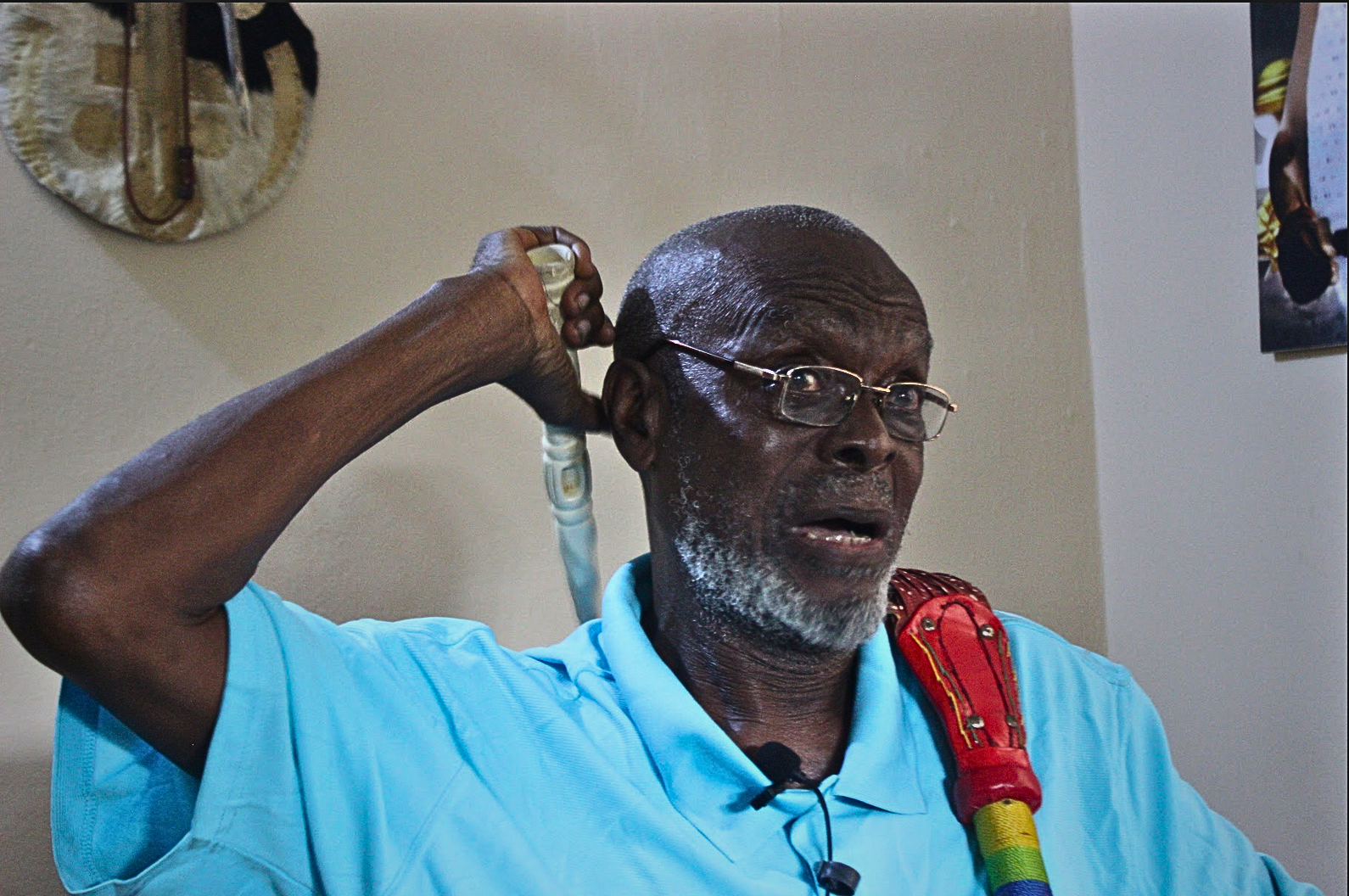
My name is Ogbueshi Oseloka Tolefe. Tolefe is, T-O-L-E-F-E. I was born on the fourth day of March, 1945. I had my primary school days in Asaba under the full care and view of my parents, Ogbueshi Onumba Tolefe, that’s my father. My mother, Mrs. Anna Tolefe, they were my parents and I grew up with them. I came from a family of six — three boys, three girls — and we all went through school under the guidance of our father, our parents and fortunately, for all of us, we all went through school and I was out for the secondary school in 1965. And after which, I took to an employment in 1966 in the then-Midwestern government. I was there until the coup of 1966. And the preceding things that happened is everybody’s knowledge. And it led to the civil war. Well, you can say that the massacre in the North directed on certain persons was on and eventually — I’m not going through all the details of it, eventually that led to the pronouncement and declaration of Biafra, as it were.
“And it was after I got there, after a while, that I got the news that my father was killed.”
And then the shooting war started and the Biafrans go through the Niger Bridge and got into Asaba, and then were heading westwards. After a while, after a orie, they were kind of stagnated and they were not moving forward. They were not doing anything until the federal government brought their might onto the war and [pushed] the Biafrans back. In the effort to safeguard themselves, the bridge was blown at the Onitsha end. Well, a lot of things happened. My knowledge and what I can remember is what I’m going to give here. No one person has it all. But a little bit you have, you honestly tell. And if you do that, and every other person does their own bit, you will have the story complete.

“There were a lot of Asaba men and boys, children massacred. My father was one of them.”
So what I’m doing now is my side of the story. What I saw, what I did, and what happened to me. Eventually, the federal troops were around the whole place and got to Asaba. And I was forced to leave Asaba. My parents stayed back, and some of my sisters stayed back and I got across to Biafra.
And it was after I got there, after a while, that I got the news that my father was killed. My father was then 74 years plus. I wonder what it would mean that a 74-year-old man could have been a soldier and was taken to a place called Obusuga where the pogrom was hatched. There were a lot of Asaba men and boys, children massacred. My father was one of them. His younger brother was also involved and he was also killed. Now, I don’t think there’s anybody who will have that kind of experience and laugh over it. I valued my father a lot. We were friends, we were not father and son. We were very good friends, very, very good friends, intimate and there was nothing happening in the house. I was not consulted. Consultation in the sense that I should know, not that I had, I could change it. But be it as it may, I was very close to my father.

My eldest brother, I didn’t know him physically until about 1959 when he came back from the UK. He was a civil engineer and for records, he was a consultant to the construction of the Niger Bridge linking Asaba and Onitsha. He then was working for Texaco Oil Company, from Texaco Oil Company, he became a civil engineer with the Federal Ministry of Works. That was how he got to supervise the bridge. Well, that is the short background story that there was and the war came on.
“…there are a lot of stories that were told about the massacre of men, mainly in Asaba.”
I ran for my dear life. My father was not ready to leave; he stayed back. Well, I think I supported his move to stay back because [the] man has 74 years. What is he running away from? He was convinced about staying home. He was the person that is looking after the house and the home. Incidentally, he was killed and I got the news across that he was killed. And I didn’t like it at all. Well, the summary of it is that out of the anger and frustration of my father’s death, not that he died naturally, somebody shot him under command. I wasn’t there, but I was told the story and there are a lot of stories that were told about the massacre of men, mainly in Asaba. Well, that was that and I was in Port Harcourt and there really wasn’t anything for anybody to do.
“If I was going to die, let me die in the field.”
And my eldest sister then was in the customs in Port Harcourt, and that was where I took refuge. And incidentally, I found it boring. I am the type of person that I didn’t like idleness. I wanted to be doing something at any time, occupy myself because they said the idle mind is the devil’s workshop. I think that’s correct and I now asked myself, my father was no more. I wasn’t even sure [where] my mother was, because there was no way I could contact anybody. I then took a decision that rather than stay here and be killed like my father was killed, I should at least struggle a little before I’m killed. So that led me, I changed my mind and decided I was going to join the army. If I was going to die, let me die in the field. Not somebody walking into the house and shooting me.

And that led me to joining in the army. I joined the army and I was taken in as an officer cadet. I went to the military school. I was commissioned as a second lieutenant and apparently I was retained in the School of Infantry as an instructor. And I was there in the School of Infantry for a while and then finally I was posted to the field. I was posted to the field and I was in what they call the R.O.B unit, Republic of Benin unit. My division commander was Colonel J.O.G. Achuzie and I was a company commander in the army and I led a unit of the force. The unit I led was called the Kwale Strike Force. In fact, all the strike from Ogboakuba on the east, crossing the Niger to the right Uchi, and then to Oko and down to Kwale. So that’s why my unit was called the Kwale Strike Force. And that was where we were and we fought extensively and everything.
I was hit twice, one on my right shoulder, second on my thigh. But thank goodness I am full and whole today. I didn’t die by the shots. That was my experience of that. And the war continued and eventually I left the front line and I was back to administration. I worked with the refinery. I wasn’t producing oil, I was working as an administration officer, administrative officer. And, you know, administration. And it continued like that until, well, there are a lot of things that I will not mention here. Because the sequence in which they came.
The experience I had in Onitsha at St. Charles, St. Charles College. St. Charles became a boiling point where we had the army unit, army headquarters and all that. Battalion, brigade headquarters. And we were taking orders from them, covering our area. Colonel [Joseph] Achuzie there was the Brigade Commander and there was one Major Eze, I don’t know whether he is still alive now, he’s from the East and we all did our best. Then Colonel, Major Nzeogwu was part of us until he died fighting in the Opi axis of the war and we continued from there. Well, it’s not everything I can remember now, but the salient things I can remember I will mention.
The civil war went on, on and on. Then the federal troops were threatening from the South. They had taken over Port Harcourt and they were heading to Owerri. Well, I was commissioned to, I had now left the front line because I had some injuries that wouldn’t allow me to operate in the front line. I was now brought to the rear to evacuate Owerri to Umuahia. And I did my best. We evacuated as much as we could. And eventually Owerri fell. And the pressure was now moving into Umuahia axis. Then I had left that zone. And I was then in Okigwe-Olu area, where we had the School of Infantry. And I was back as an instructor in the School of Infantry. Well, there we stayed and Colonel Achuzie was the commandant. And the war went on. Finally, finally, I’ll give you a brief recording because it’s not everything you can remember now.
The little I can remember or the much I can remember is what I’m talking about. Finally, finally, here’s a summary of whatever happened because I can’t give you all the details. Then, that was January 10th, 1970. I think that date is right. That was when actually we turned in the towel. And it was Colonel Achuzie, myself, Efiok [sic] that met in Olu, I can’t remember the name of the girl’s school again. That was actually where we handed over. And the war kind of technically ended to Brigadier Obasanjo. He was the person we handed over to and that signified the closure of my military, whatever. But then, it wasn’t all of it because, well, in Nigeria, my experience of life in Nigeria is that there are gossips all over the whole place. Even inside your own family there are gossips. There are persons that don’t even think good about persons, they go around telling stories and telling tales to implicate and injure people. And I was a victim of that too. Stories went around flying that I was the person that didn’t allow the war to finish. I wonder what one single person could have done to stop a war. So, I was invited by the police. Eventually, I went and I was detained.
“Well, I went and enlisted myself because of what I felt about my father’s death.”
I was sent to Benin. And it was by the mercy of, there are persons I can remember who worked for my freedom. There was Dr. Alana who was the unit doctor in my unit. Late, Iyase of Asaba Obi .J. Obi, what’s his name again? Onyeobi He was then the head of service and secretary to the state government in Benin. He fought very much for my release and that was how I left detention and I went back home. Then, I saw that my military whatever was over and I accepted it was over and I had to move forward. Eventually, I left the shores of Nigeria and I went to the US. By the aid of my cousin, late Ambassador Vincent Sonny Okobi. We were cousins. In fact, his father was killed alongside my father. So, with his aid and help, I was out to the US and I spent some time, went to school and all that. And finally, I got back in 1979 got an employment with the New Nigeria Bank worked there until 1994.

Yeah, the School of Infantry was where military cadets were trained. It’s like, it’s a School of Infantry, you know, school where you are taught about the military, how you can fight, how you can defend, how you can be conscious about whatever, whatever it is. It’s a whole bunch of things. The long and short of it is, you were trained in the use of firearms, trained military tactics, and first of all, you have to be safe. You have to see and don’t be seen. If you are in the front line, that’s what you take with you to the front line. See and don’t be seen, that is one of the instructions, Kill and don’t be killed. If you have to fight, pick out the enemy before the enemy picks you. So, these are the principal things you are taught, when you go through. You do mock battles, mock shooting and all that to teach you what it is like, to take care, be careful, save your life and save yours. So, that is exactly, in brief, that’s what the School of Infantry is. The School of Infantry is to take care of you, teach you what to do in the field, teach you how to save yourself and save others, and kill the enemy before the enemy kills you. That’s the summary of it.
Well, I went and enlisted myself because of what I felt about my father’s death. I went there turned in myself that I wanted to be a soldier. Well, like I said earlier, my father was my best friend and if my father was my best friend, and my father was killed by somebody, and I’m able to find out who killed my father, definitely you’ll want revenge. So, I didn’t know who killed him, but I knew the circumstances in which he died and the same circumstances could have befallen me, but I was saved by God. I was moved out of the scene and I still continued my life and I’m still living today.
Well, before you are retained, it is like when you are in school. You do your exams, you do your lessons, and you do your exams, and there is an examination at the end of the session or whatever it is. Your performance tells whatever you are going to do. There were several of us that were retained, I wasn’t alone. It wasn’t me alone that was retained. Some of us were retained in weapon training, administration, whatever I was in weapon training and eventually, I think that led to my being, getting the post of a commander. Well, I thank God I’m alive today to tell this story.
“I got infuriated that somebody could wake up and kill a 74-year-old man for nothing.”
Well, it was an emergency kind of thing. Ordinarily, if it was in a peaceful era, it would take you a few years to graduate. But because of the necessity of control and direction, as at that time, you didn’t go that length of time. After all, the war was on for how long? From 1967 to 1970 is that enough to…. that is not actually enough to breed somebody of excellence? You know, I don’t know. But then, because of the exigencies of the things then, you were rushed through training. And well, some of us retained good memories of what we went through and we were able to pass it on to the people who you finally led as their commander.
Well, normally, it was a full-fledged army [Biafran Army] and when you talk about a full-fledged army, even though it wasn’t the size of what you would call an army, but it was an army, alright. You had departments, medicals, this, that, recce squadrons, and you know, everything. You managed all of it, and by the grace of God, we survived up to the time we did. The School of Infantry was a complete school, complete school in the sense you have the military, you have administration, you have medicals, you have this, you have that, you know be it bits and pieces or whatever you want to call it, because of the war situation.Well, I would say that what we experienced in Biafra, if it was a war that was planned for over many years, it would have been fantastic.
Well, you see the populace around all these areas, they were willing and ready to support. Food, yam, cassava, whatever, whatever was coming all the way from the Anam area. They are very fertile areas and they were producing most of the food. Many other places they were contributing. And don’t forget that at that time you had the surge of refugees from the troubled areas. They were all converging and whatever it is. The army was doing its bit. There were some refugee camps around the place and the little they could, they were offering. Just to survive people. It wasn’t exactly a situation anybody would have loved to be in because it wasn’t planned for. It was not planned for and we did the best out of what situation we had. I’ll just tell you my side of it. My side of it was I got involved, I got infuriated that somebody could wake up and kill a 74-year-old man for nothing. Just because he had a weapon, It happened to me in the front line. I went to the front line to fight.
Well, I didn’t work directly with him [Nzeogwu] but we, after his death, my unit took over his unit and it was then proudly called, his unit was BA-007, Biafran Army 007, and when we took over the unit after his death, we also renamed our unit BA-007, in memory of him.
I already talked about him [Major Achuzie] in the process, well when I was shot, I was shot under his command, that is, I was in the unit that made up, we have units that make up a brigade, and I was in one of the units, I was a commander there, and when I was shot, when I had to come back, he was always coming to visit me to find out how I was doing, and that’s it.
Well, the whole thing is, you can’t break them, bit by bit. You see, we collected every bit together, and that was the height of it. You see, it’s like, if you’re, let me say it this way, if your source of livelihood was snapped short, you will react. My father, like I told you, (unintell.), was my very good friend and father, and pilot. He took me through the strong and difficult periods of my life, and just at the time I was ready to settle down and say, Papa, you can rest, let me do this and do that for you, they killed him. So that’s enough to ginger anybody into anything, at least for me, (unintell.) I had a focus. This was what drove my focus because you don’t just kill somebody anyhow, for no reason. I can understand if my father was in the army, and he died in the process, that’s a different issue. But to whisk out a 74-year-old man from his house, and shoot him in cold blood, that’s enough to inspire you into anything. I didn’t need another high point to remind me.
Well, the war has come and gone. There are a lot of lessons to learn and the reconciliation is not complete yet. Several persons are being victimized and for us to get completely reintegrated, more has to be done. The politicians are not helping matters. Everybody is struggling for his pocket, legally and illegally. It’s not too good. Let’s not get into a situation where, if you say your mind, you’re persecuted. If you say your mind and there are truths in what you have said, let it be looked into. And right the wrongs, and we’ll flow.

Well, for me, that was the end of the civil war (the surrendering) and there was nothing anybody could do about it. We were not thinking about what they were going to do to us, whatever you did to us, oh well. If you started a thing and you’re convinced about what you’re doing, there’s nothing too difficult to bear because what if we had been killed in the process? If those of us who survived had been killed in the process, it would have been the same thing. But the fact that we fought a cause we believed in, that was the joy of it. There are some of us that lost our friends, dear friends, mates and counterparts and all that, they were not around to see the end. I was around to see the beginning, the middle and the finish.
I count myself very lucky and grateful to God that at least I have something I can tell people coming behind me, this and that and that happened in my presence. I was part of this, I wasn’t part of that. So the little bit I can remember is what I just let out to you.
This interview was conducted in Asaba, Delta State by Chukwuebuka Okoye in September 2025 for Biafran War Memories, a program of ZIKORA Media & Arts African Cultural Heritage Organization.




Leave a Reply