
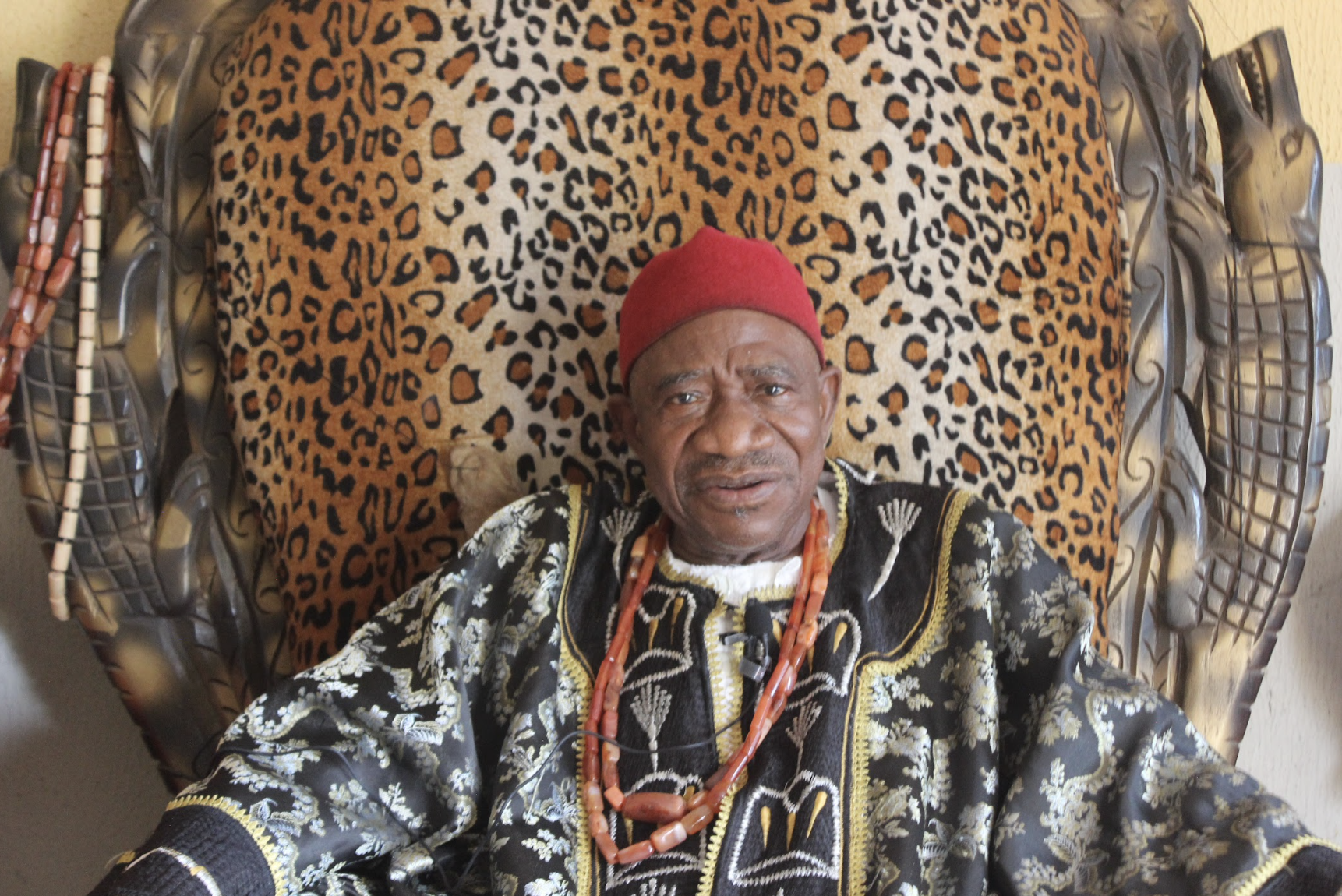
I am His Royal Highness, Sir Joseph Chukwuemeka Ajedo, the King of Okpanyele Ukwala, in Anambra West Local Government. I [was] in All Saints Grammar School Umunze, that was 1967. So that time I was still a child. We didn’t know what was happening, just that they came one day and said everybody should go. We all went home happily. We didn’t know that it was war they are preparing. I went to Fegge Onitsha, where I was living with some people, not up to a week with my cousin came, saying that my grandmother requested I should come back. I said, OK. You know children, whatever they told you, you follow it with happiness. We went to Ose Okwodu market currently in Onitsha to by ibolo fish, it was during flood season. So we bought the fish and traveled to the village. I went to live with my father and mother in the camp where they live, but I was there. Then later on, I went to stay with my grandma in the town then we go to farm, we return home. Then I started fishing. I love fishing. After farming, I go fishing. So not quite long, I might not remember the dates, around July, they said that Onitsha has fallen. The war has started. The first thing is that God saved me. You know, the elderly see beyond (laughs).
“They said they are Biafra One and we are Biafra Two.”
She [my grandmother] insisted that they should bring me back. My grandmother was disturbing them to bring me back. As I came back, not up to a week Onitsha fell. So we stayed in the village going to farm. We were hearing about the war later on, the military came and camped in our village between Ndi Inoma, Owelle and Ukwala is in the same area if you pass Nzam you will find Owelle, Ukwala and Inoma. We lived our normal lives, when the military needs us we go to assist them. We divide the duty based on age grade. So one day they said they are recruiting fresh soldiers, and they said it’s our age grade. So we all went there. When I got there, they said I’m too small (laughs). My age mates went but I didn’t go to war. I stayed back in the village, hearing what’s happening, how the war is going, and also working for the military. That time, we often go fishing for the soldiers. We bring it [the fish] to the village and smoked the fish for the soldiers and they shifted it. We didn’t understand what was going on. They said they are Biafra One and we are Biafra Two. They often shift the fish to Biafra One. Later on, our people contribute yam to be taken to the Biafra soldiers. We didn’t know that it’s not just for the Biafra soldiers in our community. They shift it out. That is what we do in the community. We give them food and fish. That’s what we are basically doing. Our people that went to war, later on, a few of them came back. It was said that they ran, the military came and took them and they went back. So at a time, my grandmother said I would not stay in the community again, that I should go and stay with my parents in the farming camp because I stayed with her all along, even before I went to Onitsha for school then it was known as Standard. It was that 1964. I went to Onitsha. That’s when they introduced primary. It use to be Standard. So when I got there, I entered Primary four. From there, I went to Umunze.

So the war was tough, our people from there went to Kogi at our boundary with Kogi. The people that were there, they destroyed their property and burnt it down. They were chased out of the place. They did it just to prevent the Nigerian soldiers from coming into our community through that place. So fear was everywhere. Nigerian soldiers never come in through that place to our community and that is how we prevented Nigeria soldiers from entering our community. One fateful day, I can’t remember the date, I can’t remember the month. Everywhere was quiet they said that the Nigerian soldiers’ boats were heading to Onitsha. So the Biafran soldiers in our community and neighboring communities like Nzam, Anam opened fire on the Nigerian soldiers, but how God favors Biafran soldiers is that they gunned down the boats and it sank in Oroma-Etiti in the middle of the river and everything inside of it sink and were destroyed including the soldiers and food inside the boat….we don’t know the details of what the boat was carrying all of them sank. Big ship, so it’s after the war, when we are heading to Onitsha, we always see the boats, that time the rivers, have gone down, so you’ll be able to see some part of the boats.
We were following the news of the war. So there is this one fateful day our age grade are the ones on duty, protecting the community. So the Biafran soldiers said that we are going to assist them. Captain Nwakammuo — he is from Awkuzu. I saw him last year or last two years. He was heading to Nzam, he said we should carry him with our canoe. We carried him to Nzam with our canoe when we got to Nzam, they asked us to wait. He went to the camp, where they camped, and brought his wife with some properties, and we headed to Otuocha. Our people at home never knew where we went to. They thought we just went to Nzam, no communication that time. They didn’t know where we went to. We paddle the canoe from Nzam, we head to Otuocha there was shortcut at Oroma from there, we head to Otuocha, and we came to Umwezanam. The military there shouted, who goes you, who goes there? And the captain asked us to slow down, so that the military would know that we are not the enemy. Then he introduced himself as Captain Nwakammuo, and they allowed us to cross. Hunger dealt with us that day, because we never ate our breakfast before going. We hoped that when we get to Otuocha, we would search for what to eat. We said, let’s go and get bread and some drink but coming out from our canoe. We can hear the sound of bullets and jet fighters. They say it’s happening in Abagana sector. We are hearing the soundless too much. We ran back to our canoe (laughs). We started heading back.
“So that time, people suffered but in our side, we didn’t suffer.”
We got to Umuewlu-ana. There was one of my classmates, from All Saint Umunze. I saw him there. So we decided to branch there to see if we can find garri or anything to eat. When we got there, it was my classmate we meet there. He shouted and welcomed us into his house he gave us garri , fish and coconuts and we eat. That is what we enjoyed and they all were very happy. They said that it is good to know people and that how we entered the boat and went home. We got home the following day, something that we left in the morning. It was the people that are from Nzam told our people that we went to Otuocha. So we got home the following day, that is that experience. In our side. What we are doing for the Biafran soldiers is to give them food and they ship it down to other places.There are diseases that we are able to cure during that period. Jiga, disease that has to do with the legs, if anybody contact it, the person will come to our side and get treated using the herbal medicine. Even kwashiorkor patients, when they come to our place, we also cure them. We have the traditional medicine for it and there is enough food. From our own side, in the other side, Orumbanassa-Odokpe they are opposite Edo. Any day that there is no operation, they cross over to Edo to get salts. So they enter canoe and cross River Niger to get salt, and they will sell it to people, with there canoe they cross the big River Niger. So during that time in our side, we suffered but not that much because there is food and ingredients for cooking was also available. So this is what I know about the Biafran war. I experienced it, I can say I took part in the war since I went to Otuocha and ran, paddled a captain. If it is now, it should be a car but it was our canoe. So that time, people suffered but in our side, we didn’t suffer. I will tell you the truth.

In 1970, they said the war was over. Just one day. It was just like a rumor that the war had come to an end, people were surprised we were just curious. People that went to war started coming back, but what pained me most that day is one of my age grade that went to war died that very day. So it was personal to me. I grieved because he was my close friend even before I went to Onitsha, we all went to school together. We were close, even though that sometimes we do fight. But we are still age grades. So that is how it is. There are people from our community Ukwala. My own village Okpanyele, three people never came back. My village Ukawala three people didn’t come back so those people went to the war that is what I know about the war. Yes.
“The person with gun is bigger than you.”
They called us Biafran Two. I cannot really explain why they called us Biafran two, maybe because we supply food to them, most food supply came from our side. So people from our side which is currently Anambra West and some part of Anambra East supply food to Biafran during the war. Yes, people ran to our community for refuge, like the man I was living with before, who is from Agulu came to our community for a refuge and some other people also came for a refuge. When they come and see how calm the place is they settle and join in the farming. Sometimes there would be rumors that Nigeria soldiers are coming, people will run but at the end they never entered our community. It is after the war during the rainy season around 1969 that the army, Nigerian soldiers entered our community for the first time. The war was already over then. They just came around, we were looking at them, they are looking at us. That day, I was heading to the river to fish. I was in my canoe with my machete. The Nigerian soldiers came and slapped me, accusing me that I wanted to attack him with my machete I was going fishing (laughs)…. The person with gun is bigger than you. There was nothing I could do.
Camp is where we farm. We live there so in the morning you just head straight to your farm when you are done farming you enter your camp so we build that house there we do it so it will be easier to enter the farm if you are in the community. There are other community engagements that might prevent you from farming. But when you are in the camp you will not hear about meeting or anything once it is morning you enter into your farm. Even now, people are still in the camp so it will be closer for them to farm instead of having to be trekking from the community to the farm you just stay in your camp and go into your farm.

This interview was conducted in Awkuzu, Anambra State by Chukwuebuka Okoye in August 2025 for Biafran War Memories, a program of ZIKORA Media & Arts African Cultural Heritage Organization.





Leave a Reply