

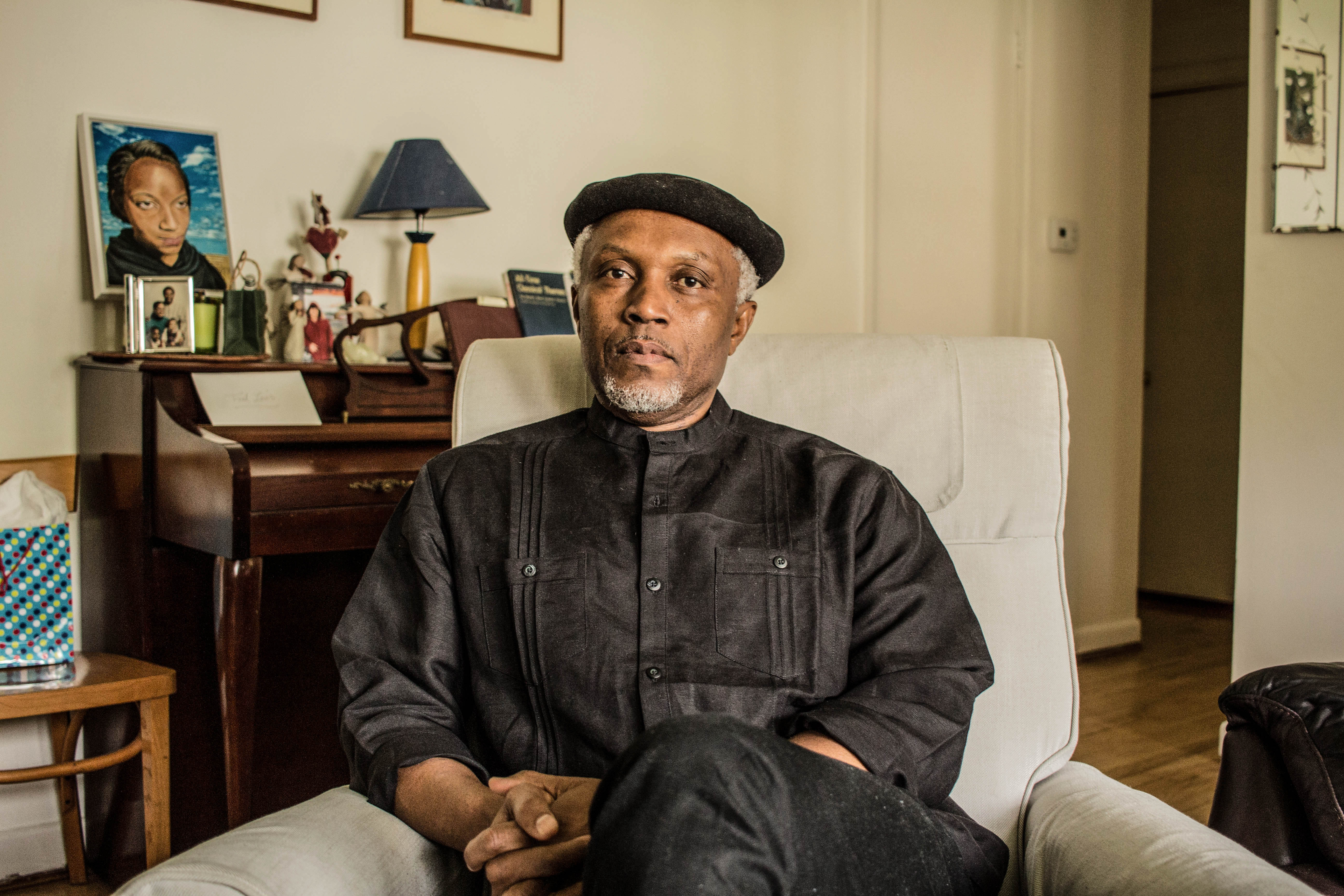
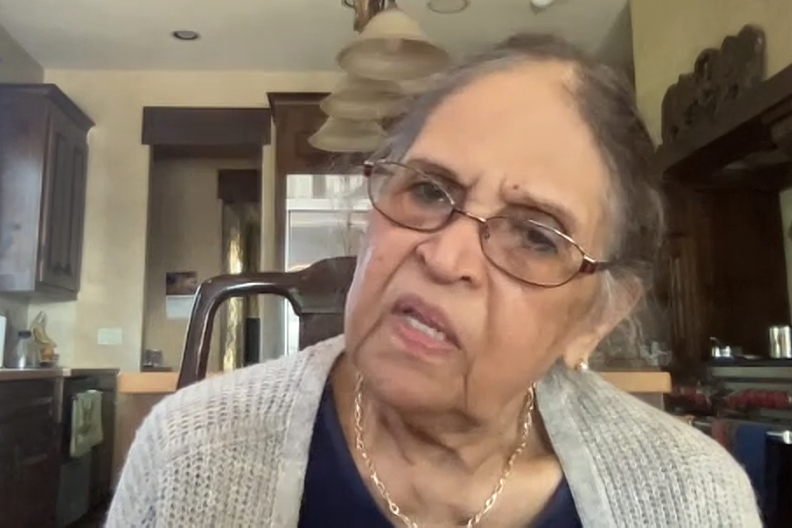
Okay. Mm hmm. My name is Reverend Father Professor G.C. Abiogu from Orlu main town in Imo State. I was born in nine, uh, uh, in, uh, 1948. By the time I entered the seminary, I was, uh, about, uh, fifteen years when I entered. So I was moving in the seminary and came to, I was in form four when the war broke out. And then we were so happy that the war came up because every person is anxious, especially with what happened before the declaration of war. People were dying in the North, corpses being brought. Some of our relations, some we know, some of our friends’ brothers, sisters, even parents. So every person was anxious to be on his own rather than be saying, “We are in Nigeria and look at what is happening.”
“By the time I entered the seminary, I was, uh, about, uh, fifteen years when I entered. So I was moving in the seminary and came to, I was in form four when the war broke out. And then we were so happy that the war came up because every person is anxious, especially with what happened before the declaration of war…” Reverend Abiogu’s voice recorded by Chukwuebuka Okoye
“So every person was anxious to be on his own rather than be saying, “We are in Nigeria and look at what is happening.”
So we were eager to go and serve even if we are to die. And, uh, prayers were being said that there may be peace. Some of us who are so young were saying we want to ex- we want to experience especially, uh, bombing, all those things, to experience it physically. These things we are, uh, just seeing in the play, to see it physically. So that was even like myself driving me that time. So when we were in the school then, it was nearer to Aba and they had… The, priests telling us that now the Nigerian soldiers are pushing into Aba. Mmm. And they said, “Now seminarians, we have to go for our safety.” And that’s how the seminary closed. And we were told go home. We came home. I was at home seeing my age mates joining force a- and I was, uh, worried that why can’t I? So that was how I decided to join the force even though my parents were not happy that I’m going there and, uh, the then parish priest was a white man, was not happy. But I insisted to go.
“So when we were in the school then, it was nearer to Aba and they had… The, priests telling us that now the Nigerian soldiers are pushing into Aba….” Reverend Abiogu’s voice recorded by Chukwuebuka Okoye

“So we were eager to go and serve even if we are to die.”
Then reaching there, at the initial stage, I was, uh, enjoying the camp life. Early in the morning, early parade, running, coming out, jumping, all the physical exercises. But then they take people to front. You see people coming back with parts of their body, some wouldn’t. And being told that such, such a person is dead, he wasn’t there. Eh, so myself, I didn’t experience much exactly in the war front because myself, I was in, uh, uh, uh, Biafran, 2nd Biafran Air Force Regimental Wing of intelligence section. That’s where I served. And mainly what I was doing is entering into people’s house, community, traveling, around the bushes and this to check whether there are saboteurs. To suspect every person around you to determine is this person a real Biafran troop or not, or is he a saboteur? Where is he from? Is he a soldier or not? So I was going on doing all these things. Uh, with time, and the life also was no longer as we are moving and the war, there’s no end to it.
“Biafran, 2nd Biafran Air Force regimental wing of intelligence section. That’s where I served.”
Rather hardship was in-increasing, especially hunger. Not eating well, sickness. But still with that hardship, we, we are determined to carry on since others are there until when we say they are meeting a type of Waterloo, that people are dying and the opponent Nigerian soldiers are taking over grounds we have gained and we are afraid that this may be the end of the world. But God helped us. The war didn’t end. But as the war ended, it was also a great experience. We’ll be passing on the road, some of the soldier will see us, say, “You people will die. You people were shooting us in the bush, now you are pretending that you are welcoming us.”
I know of a, a tight friend who is an air force officer. We were going on the road and one of the men there, soldiers came and said, “Yes, we will deal with you. Come, pull off your shoe. These stockings you’re wearing is Gowon property.” And they forced my friend to pull off his shoe and they took those stockings. It was very embarrassing to us. Anywhere we go, they started harassing us that, “You, you people are soldiers.” And we were denying. At times they will say, they tell you, “Stand at attention there.” We’ll be looking at them because when you stand at attention, you have revealed yourself as a soldier. But we pretend that we don’t know what they are, what they are, what they are saying. And some of them will say, “You are pretending.” So this was the experience after the war.
“…And they forced my friend to pull off his shoe and they took those stockings. It was very embarrassing to us….so this was the experience after the war.” Reverend Abiogu’s voice recorded by Chukwuebuka Okoye
…
Yes. When I came up there, I saw also my age mates in the camp [Biafran Army] there, and I saw senior men, especially the man who helped me to join the air force, uh, by name Phillip Ezenwa. Ezenwa Philip. He used to play football so much, tall man, you know. Then I met them there, and, eh, eh, the way they are carrying their life, you know, said, “This is a way to serve your nation.” So we were learning from them, and doing the same they were doing.
…
Yes, yes. My most joyful [moment in the camp] is when we listen to the news, and then the news narrator will now start telling us and announcing how the Biafran gallant soldiers have massacred people, have killed, and gained ground, and pursued the soldiers. We feel happy that we are making advance. And our morale will be so high for that war front. And when we see any person from that war front, we’ll be hailing him and looking at him as a strong soldier.
Eh, yes. Before they [Biafran radio broadcast] start, eh, there is a, eh, eh, music. That music normally use, eh, when people are gathering for wrestling in a square. Buru, buru, buru, buru, buru, buru, buru, buru, buru, buru, buru, buru, buru, buru, buru, buru, buru, buru, “ Biafrans don’t sleep for him who is surrounded by the enemy protects his life always. This is Radio Biafra,” they start. That’s what goes and as he’s knocking, taking time, then people will be shouting.
[Laughs]
That is completion of war front, that the gong is sounding so high, and our spirit is so high.
[Laughs]
Mm-hmm. Mm-hmm.
Eh, yes [Radio Biafra was a 24-hours daily broadcast] but then you will have, eh, news in detail at one [pm]. At one, news in detail. Otherwise they say news in brief. But it is one in the afternoon, you have news in detail. And you see people, eh, even in the villages gathering under the palm tree with their radio listening. And again, what encouraged us around that time is, to get the battery, you may not have the money, but we were taught how to make a, a way. You, you don’t carry the radio around. You fix it, open the back, bring the wire there, long wire distribute, that wire with the per- with the, uh, sheets that is zinc. You open the zinc, open it, and pass the wire through there and tie it on that zinc. When you tie it on the zinc, you get about four or five.
“…the Biafran gallant soldiers have massacred people…”
Yeah. You distribute the wire, about seven of them into that, that cup. And that cup, you have salt and sand inside there with water. Where that zinc tied on the wire will be inside. That’s all. That’s what we are using to tune the, tune the radio, and we’ll be listening. But each time, uh, within two days, you had to re-impose it because it will be going, it will be going down and this is how… So you see people gathering where you have fixed all this, and this is how we are getting on. And then for the soldiers who like smoking, they say you will be so high by taking by smoking. Even to get the cigarette, it was so high, so, so hard. So what, we have a makeshift cigarette and that is, that is, uh, a type of leaf. Some people call it Ǹnaayaga ebi in the sense that, in that bush, it occupies everywhere. And some people call it eh- uh, Ahihialisa because they said they discovered it by 1954 or ’57 when Queen Elizabeth visited Nigeria, it is after the visit they begin to see this, uh, uh, lea- leaf. So you get it, dry it, use a piece of pepper, wrap that dried one. Take alligator pepper and put inside it with the flower, that alligator pepper with little seeds inside the black, you put it inside and roll it. Then you, uh, you put it this alligator pepper and start smoking. Each time you draw, the light will go… You, fff, you put… You blow it up with your thing. And that black seed of the green is something I say a lighter, because you’ll be heard, “Pam,” light will be on. You blow it off. Then you start taking it. You take and pass to the other person. Others will be d- uh, uh, starting their own, so that when we need to smoke again, they will bring it out. And this is how we were making, makeshift and we do as serving, because people will tell you say, “He’s shocking them,” because of the alligator p- being burnt is the main thing there.

[Laughs]
Yes. Yes, there is [a lot of unity among the soldiers]. There is. There are people who are ready to help. They’re ready to help.
…
Yes. Those, um, uh, inside, we may go there and look at it, but many of us never flew the plane. There are special people trained who are the pilots who fly the plane. If they go back, when they be telling their story and experience, we may go around to listen, because our own is under the intelligence section mainly, going to meet people and going around to safeguard the airport. Those they have gun, but you don’t have gun, but suspecting and going round in case there is danger, that is our m- main work there.
…Yes. About the airport. That one started earlier, and Nigerian soldiers were coming, bombing, bombing, and many people were dying. After a time, it was extended more. They had to extend more and they had to blockade the road. People used to pass somewhere through the road, but they had to close it and make another way. People no longer pass through that of, uh, Uli, because the relief, it’s through that way, that airport, they were running into mainly. Then when p- people visit, foreign people and this, mainly the risk is there they are landing, because that private one near, uh, uh, Uga is not being used, because once they know it, you are revealing, uh, the secret of the war. So that one they use mainly. But that of Uga then, like there are some arms they are bringing, they take that one, because with the bombing is at the outskirts, unlike Uli, where the bombing air tarmac, they easily get it. But in that of, uh, Uga, they never got the air tarmac for even one day but outside. We were asking them for it, they said when they go on top, it sinks. That area sinks. They can’t get it easily. And so that’s why they didn’t get it. Uh, they get, uh, uh, uh, surroundings, but not the main an- airport, uh, that of Uga, until the war ended.
Reverend Abiogu’s on Uli and Uga air strips. Audio captured by Chukwuebuka Okoye.
But all the people who are safeguarding the airport, uh, that is, uh, there is an adage in Igbo that na “Mmadu taru obi agu-nkwo” (Naija language) they are ready to die. Once they see the plane they are here, they… We have already started a, started an attack. From my place Orlu and from Uga there, you’ll be hearing the sound, and the bombs are so powerful that it’s piercing the sky. You will see openings it’s making in the sky. So it was a very strong, uh, uh, weapon. And those, uh, they are… We are well, well devoted and ready to sa- sacrifice their life, and that also saved us.
“I’m going to the war front. Let me go and fight.”
…On his own, he’s [Chukwuemeka Odumegwu Ojukwu] a, a powerful speaker. intelligent, very articulate, and he has the right vocabulary for everything. So that when he addresses us as his soldiers, [laughs] you yourself can pick up stick and say, “I’m going to the war front. Let me go and fight.” And this kept us, because there were some of the soldiers I met around, uh, Benin, they w- operated at Benin, but they were cut off. My relation was among them. They were cut off. When they were cut off, the boat had to capsize. Many of them went into the water. Nigerian soldiers came, started shooting them. Thought that they have killed all of them, without knowing there was up to 30 people. They have not died. And there is a, a tree near there. They were holding the root of the tree inside the river, raised up their face, breathing, but they were dead. They were dead for over two hours. After a time, they shouted, “Please come and help us. We have not…”
“When they were cut off, the boat had to capsize.”
They said Ojukwu soldier is talking. They said, “No, if they come, they will shoot them.” They said, “No, we’ll not. Come and rescue us.” One of them, they said, came out, took his cigarette, dipped it inside the water, put it back again, put the lighter, and it lighted. He pulled up and jumped in. And that’s wh- that my relation said he was rescued. When they rescued them, they brought them, said Ojukwu soldier. And they were asking them, “Why is it you have no arms and you people want to throw away your life? Gowon is resting, Ojukwu is resting, and you are dying here, and we are dying. Why do you do?” They said, “No, that man, when he talks, you are moved. Even if you can go to war front empty-handed.” That they are not surprised. So it has happened like this. And eventually he was saved in the sense that, uh, international g- w- world, uh, organization sent news that they are coming to see the prisoners of war in Nigeria and have killed most of the prisoners of war. They gave order that these people who were captured recently should be brought. And that my relation, that’s how we were taken to, from that mid-west to Ibadan, and they were paraded on the street as Ojukwu soldier, Lactac soldier.
From there they were taken to Kirikiri prison. And he met two people, other people from my town who were in Krikri there. And two of them saw them, three of them started crying. “Is this how they have ended their life?” They were there. They were there. Those people came and visit them. And eventually they were there and survived till the end of the war. When they were taken, they were asked, “Where are you from? Your name, your town.” And they were saying, and they say this, this time they are dying. And many of them were brought to, that m- my relation, to Enugu. From Enugu, they gave them money that will help them to board and come to Orlu and when he was at Enugu, the people rushed going to look at them. And one of the relations saw him at Enugu there, because they themselves never believed the war has ended, because they were cut off. They thought they were taken away to kill them. And the question he asked that man, his name is Ben, he’s in America now, Ben Ihejirika. He said, “So Be- Ben, you were a saboteur and we didn’t know who we are fighting?” ‘Cause it was surprising him. He said, “We didn’t know war has ended.” And then they were coming, that Ben came and announced he saw him and he was coming. My people lined the hilly road they were climbed. As he was coming, saw his people, relations and he, w- with joy, he jumped from the gongoro. People caught him in the air and brought him home. Not long, he died.

…My parents were at home [during the war]. And…yeah, my dad particularly said, “Well” each time I managed to visit, he said, “We were praying, uh, to you, my son, but I know you are suffering, but I told you not to go, but you insisted. It may be God you believe in and serving you, maybe He will save you.” But hunger was a very strong weapon against the soldiers because the relief that was sent to the children and to the people really, some of them were being taken to feed the soldiers, and that relief then after a time ceased to come. And the soldiers would go in the bush, cassava we might have cultivated, soldiers would be uprooting them, cooking, eating with oil, and God was keeping them, going under the palm trees looking for kernel.
“I know you are suffering…”
People reached to that extent. And when people were contributing food in the villages and towns, chiefs would organize it. It would be brought. And what ingredient do you cook with? They cut those yam, cut it and boil and with oil. People were eating and, uh, it was keeping people, you know, they said it is strong heart that is keeping Biafra, you know.
[Laughs]
Well, uh, what I experienced, most of them I experienced was those people that were brought from the war front missing their leg or their hand, and some were bleeding but they can’t move. In the hospital, they died. And, uh, I felt it could be my turn, but what kept me, if it is your turn, this is sacrifice you can give for your people, for your, for your, for your t- uh, the nation you are fighting for, and this is what you can get. Like the other time I was watching television, a young man in, uh, from Israel got up and was discussing with another person. Well, I didn’t know I saw myself here, thus I got up. I couldn’t see one of my leg and I was told, “You love your people, Israel, and Israel also loves you more. That’s why we had to ampu- we had to amputate one of your leg for you to survive.” And my mind went back what people were suffering. And some even w- w- when you clear the front and marching, you see people decaying on the surface. You see some people, about 20 to 30 people, you don’t have time to bury them. You use shovel to carry sand and pour on the stomach and that’s all and leave and go, because of intestines, this is the one that decays so much, you know. And people were littering over there. Then another death I experienced is where you have arid, how it will cut people into pieces and eventually, they are dead. They’re not breathing. And one… Sorry. One, I saw in the village, arid around Umuowa side in Orlu that took side. The man came back from where he went for something and then the bomber pass, brrrrr. The man was eating. He rushed out, took a cover. When he took cover, his last born, a child, was shouting, “Daddy has left me to die. Daddy has…”
Uh, yes, the child was shouting. The dad with the grown-ups who ran with him earlier were inside the, uh, uh, type of, uh, where people made mound, the hole. Then the dad, when the, uh, child was shouting and coming out of the… the dad had to rush back to go and pick the child. Going inside the room, carrying the child as he was coming, pirr, he was killed with that child. Two of them died there. The other ones were s- shouting inside the hole there with people littered. But they jumped… well, had it been that he came inside that hole, he might not be, uh… w- w- we wouldn’t have died. Another experience was near our house. I came, three of my age grade, they came. We were discussing. Before we should know it, uh, the bomber passed. Nigerian bomber passed, he didn’t go far, turned. As we were there, we looked up. We see w- w- releasing the bomb, and in the air there, it was like a coconut, this one we call, uh, uh, uh, uh, uh, dwarf coconut, Akinwanshi. It was in, in about seven of them in the air, coming down. At the back of the house, we were there, lying flat. There were, uh, uh, neighboring neighbors who were staying there. The man came back, he’s a government worker, came back, went inside the home. Instead of lying down, he held the, uh, uh, uh, uh, coconut tree there. He held it there strongly, and one of those things, uh, uh, the bomb fell there, exploded, cut that coconut. As you were cut- it cut the neck also. And that people, after that, people were shouting and come, we came down, saw him bleeding, but the head was not there. So the corpse was carried to another person. After three days, the head was seen on a tree. When they caught it, they carried it. The man is Alphonsus Otimbu. And that’s how he died. So it was horrible. The sight was horrible for me.
Well, about the war, with that difficulty, the soldiers, many of them became enemy to Biafra they were defending because of hunger.
[Laughs]
So that they could come to a person, a person’s house, loot from the barn, yams. They will eat. Like my grandfather was, uh, one of them on the side of my mother was alive by then. And you hire people to come and cultivate, and we tied his yams in the barn. And then the Biafran will come and say, “We have to collect some to feed soldiers, because they have nothing to eat.” And the man will say, “How can they do that?” He said, “They have to do that.” And with force, they will collect it. And meanwhile, he was sad that his grandson, that is myself, is in the war serving. His lastborn is a soldier, he’s in the war also serving. And how can they come to take this? Then after the war, the Nigerian soldiers came and we were quartered in eh, ooh, eh, eh, g- uh, uh, uh, school that is TTC Teacher training BHTC Orlu, which was training school Olo. They were quartered there and people were running away, hiding themselves. This my grandfather, elderly man, he say, “We go and look at those soldiers.” People said, “Don’t go there are killing.” He trekked and went there. A distance away sitting on the fence watching them. And that morning, the Nigerian soldier were cooking.
He continued telling the story how the Nigerian soldiers were, um, uh, um, their kind k-k-kind, more than that of the Biafran he were telling me, that the Biafran will come and collect his yam. But the Nigerian soldiers will give him food and were telling me that food they gave him, there is mangle inside it. Plenty of them, he has not been eating for years. It helped him a lot. We fought kind hearted people. . The Biafra give him food, that they were stealing his own. But this gave him food. So that impression lasted till he died with him.
[Laughs]
… that is, you know, criminal acts going on. Like people, they see a person they start beating him in order to get money or get food item. But I couldn’t do that. I still couldn’t do that with any person, but I will ask. If they give me, I’ll take. But there was a time I was traveling with another soldier. We hadn’t pass and we’ll be in trouble if we are caught on the way. I were trying to trace my way home to see whether I can get food at home. As we are moving, we, we hear sound of a vehicle.
“…criminal acts going on…” Reverend Abiogu’s voice recorded by Chukwuebuka Okoye
We, we entered the bush and take cover because you don’t know whether there are officers going. We hide. And when they pass, we continue. And there was one, we entered inside the bush. We were two, myself and my friend. We were inside the bush. The car was moving and they stopped near us. And he said, he said Oh boy, “We are finished.” We suspended breath and were there. And we heard a person say, “Please, please, please.” They opened the car and dragged that fellow out, went inside the bush. Pop, pop, pop, pop, pop, they shot him, and went back and moved their vehicle.
We were shivering and we were speculating it may be is, uh, their enemy. They used that opportunity to kill their enemy, or it could be a saboteur. Because when they are sitting down, you just do away with them. And we were thinking had it been they discovered us, what would be our fate? They would have killed us also. And these were army officers, Biafran army officers. We saw their paper and everything. So we were there for over 30 minutes. We had, uh, our, to recover our breath and we continued. But this thing, we are no- we are not… we were going the road, we decided to be taking winding path also moving. We were moving and came at a place, saw a place where they spread palm kernel. We went there, asked the people, “Please can you give us drinking water?” Which they gave us. Before they could bring the drinking water, we said, “Please, can allow us to be cracking, to crack this kernel.” They said, “No, you are free.” Then we were cracking it. Was cracking with the other man, eating,eating. The women there started crying that this is their children of human beings. Look at what they are suffering. The woman went in, brought tapioca with water.
“Pop, pop, pop, pop, pop, they shot him, and went back and moved their vehicle.”
And served us that. Huh, we thanked her by taking away that palm kernel. After that, we continued. When I came home, one girl from my place is working in relief center. I trace her and came there. She saw me. She said, uh, “But, uh, why… Well, I wonder why you went to join force being a seminary. We are not conscripting you first.” I said, “Well, it’s to ser-” “You are serving. Look at yourself now, emaciated and this.” I was laughing. She gave me relief, corn meal, already prepared. I was eating it. After a time, I had to wrap it and put inside my kit so that when I go back, I will… She said, “Ah, have you finished the food?” I said, “Yes.” She said, “You have not finish it. You are telling lies. You have joined the force and telling lies like them.” I said, “Well, I want to reserve the one I will take home.” She said, “Eat it. I will give you the one you will take home, even the one you will travel with.” I finished it and she gave me, uh, another one, even raw one I can take to the camp. I thanked her. Then I was happy. She was alive when I became a priest. And she still communicates with me, married, now living in Los Angeles, Amer- America. When I was writing my, looking for my Thomson Reuters impact factor papers, money difficulty, I called her and told her my difficulty. And there was a time she sent me $10,000 which helped me out.
This interview was conducted in Nsukka, Enugu State by Chukwuebuka Okoye in August 2025 for Biafran War Memories, a program of ZIKORA Media & Arts African Cultural Heritage Organization.



Leave a Reply